

How Does Mitosis Ensure That Each Daughter Cell Has The Same Genetic Makeup As The Paent Cell?
What Is Mitosis?
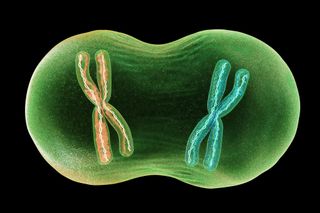
The primary mechanism by which organisms generate new cells is through prison cell division. During this process, a single "parent" prison cell will divide and produce identical "daughter" cells. In this way, the parent cell passes on its genetic material to each of its daughter cells. First, however, the cells must duplicate their DNA. Mitosis is the process by which a jail cell segregates its duplicated Dna, ultimately dividing its nucleus into two.
Cell partitioning is a universal process among living organisms. In 1855, Rudolf Virchow, a German researcher, made a primal ascertainment about all living creatures: every cell originates from another cell, or "omnis cellula e cellula ," in the original Latin, every bit writer Myron Shultz recounts in a 2008 article in the periodical Emerging Infectious Diseases.
The mechanisms of cell partition vary between prokaryotes and eukaryotes. Prokaryotes are unmarried-celled organisms, such as bacteria and archaea. They have a simple internal structure with gratuitous-floating DNA. They use cell division every bit a method of asexual reproduction, in which the genetic makeup of the parent and resulting offspring are the same. Ane mutual mechanism of asexual reproduction in prokaryotes is binary fission. During this process, the parent cell duplicates its DNA and increases the volume of its jail cell contents. Eventually, a fissure emerges in the center of the jail cell, leading to the formation of two identical girl cells.
The cells of eukaryotes, on the other manus, have an organized central compartment, chosen the nucleus, and other structures, such as mitochondria and chloroplasts. Near eukaryotic cells divide and produce identical copies of themselves by increasing their prison cell volume and duplicating their DNA through a series of defined phases known as the cell bike. Since their Dna is contained within the nucleus, they undergo nuclear division as well. "Mitosis is defined as the division of a eukaryotic nucleus," said G. Andrew Hoyt, a professor of biology at Johns Hopkins University, "[though] many people apply it to reflect the whole cell bicycle that is used for cell duplication."
Like prokaryotes, unmarried-celled eukaryotes, such equally amoeba and yeast, as well use cell division equally a method of asexual reproduction. For complex multicellular eukaryotes like plants and animals, cell partitioning is necessary for growth and the repair of damaged tissues. Eukaryotic cells can also undergo a specialized grade of prison cell segmentation chosen meiosis, which is necessary to produce reproductive cells like sperm cells, egg cells and spores.
Stages of the eukaryotic jail cell cycle
The eukaryotic cell cycle is a series of well-defined and carefully timed events that let a cell to grow and divide. Co-ordinate to Geoffery Cooper, author of "The Cell: A Molecular Approach, second Ed." (Sinauer Assembly, 2000) most eukaryotic cell cycles take iv stages:
G1 stage (first gap stage): During this phase cells that are intended for mitosis, grow and behave out diverse metabolic activities.
South stage (synthesis phase): During this phase, the cell duplicates its Deoxyribonucleic acid. Eukaryotic Deoxyribonucleic acid is coiled around spherical histone proteins to create a rod-shaped structure chosen the chromosome. During the S phase, each chromosome generates its copy, or sis chromatid. The two sister chromatids fuse together at a point called the centromere, and the complex resembles the shape of the letter "Ten."
G2 stage (2nd gap stage): During this phase the cell continues to grow and generate proteins necessary for mitosis.
(G1, S and G2 phases are collectively referred to as "interphase.")
Grand phase (mitosis): Mitosis involves the segregation of the sis chromatids. A construction of protein filaments called the mitotic spindle hooks on to the centromere and begins to contract. This pulls the sis chromatids apart, slowly moving them to opposite poles of the prison cell. Past the end of mitosis each pole of the prison cell has a complete prepare of chromosomes. The nuclear membrane reforms, and the cell divides in half, creating 2 identical girl cells.
Chromosomes, get highly compacted during mitosis, and tin can be clearly seen as dense structures under the microscope.
The resulting daughter cells can re-enter G1 stage only if they are destined to divide. Not all cells need to split up continuously. For example, man nerve cells finish dividing in adults. The cells of internal organs like the liver and kidney separate only when needed: to supercede dead or injured cells. Such types of cells enter the G0 phase (quiescent phase). They remain metabolically agile and only movement into the G1 phase of the prison cell bike when they receive the necessary molecular signals, co-ordinate to Cooper.
Stages of mitosis
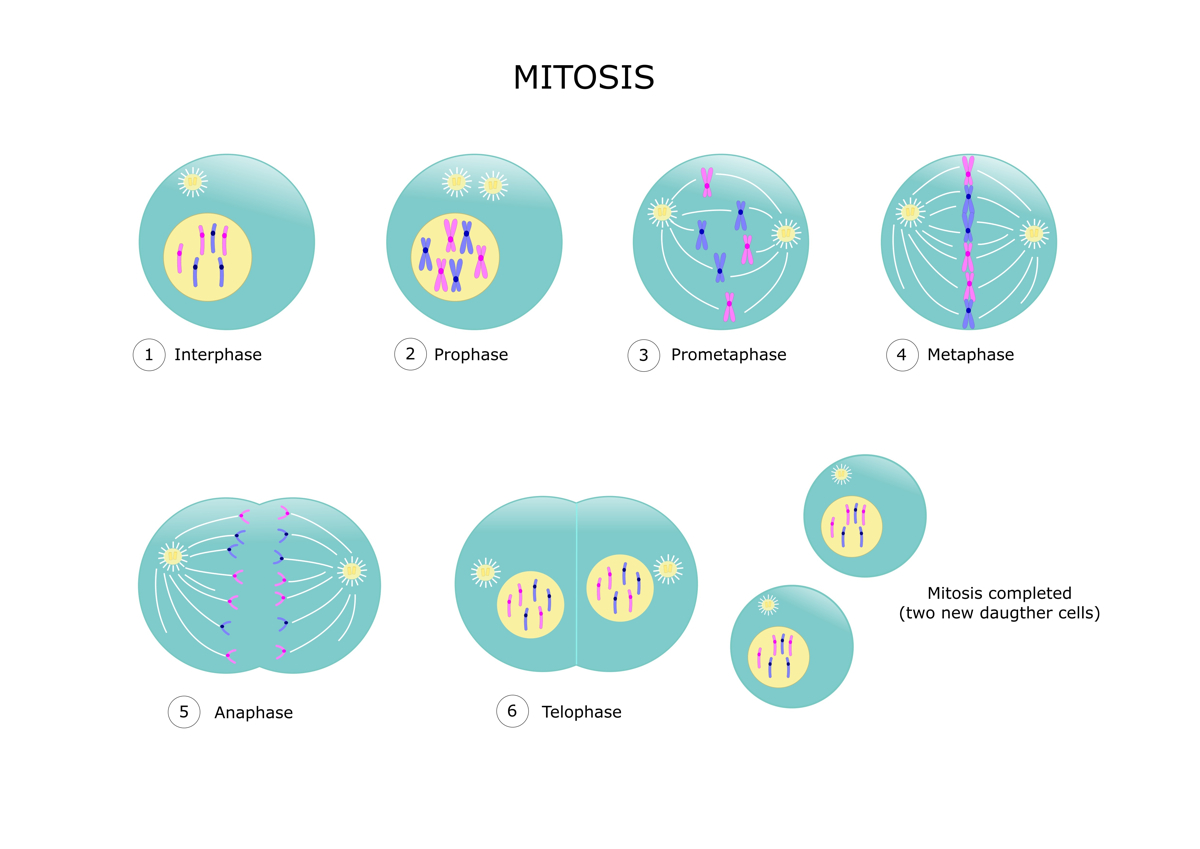
Mitosis is divided into four stages, according to course materials from the Academy of Illinois at Chicago. The characteristic stages are also seen in the second half of meiosis.
Prophase: The duplicated chromosomes are compacted and can be easily visualized as sister chromatids. The mitotic spindle, a network of protein filaments, emerges from structures called centrioles, positioned at either end of the prison cell. The mitotic spindle is flexible and is made of microtubules, which are in plow made of the protein subunit, tubulin.
Metaphase: The nuclear membrane dissolves and the mitotic spindle latches on to the sister chromatids at the centromere. The mitotic spindle can now movement the chromosomes effectually in the cell. "You can make an analogy to a girder that'south property up a skyscraper," said Hoyt. "Except the girder can assemble and disassemble very apace. They are structural elements that are extremely dynamic." By the finish of metaphase, all the chromosomes are aligned in the center of the prison cell.
Anaphase: The mitotic spindle contracts and pulls the sister chromatids apart. They begin to move to opposite ends of the prison cell.
Telophase: The chromosomes reach either end of the prison cell. The nuclear membrane forms again and the prison cell body splits into two (cytokinesis).
At the terminate of mitosis, i prison cell produces two genetically identical daughter cells.
Cell bicycle regulation and cancer
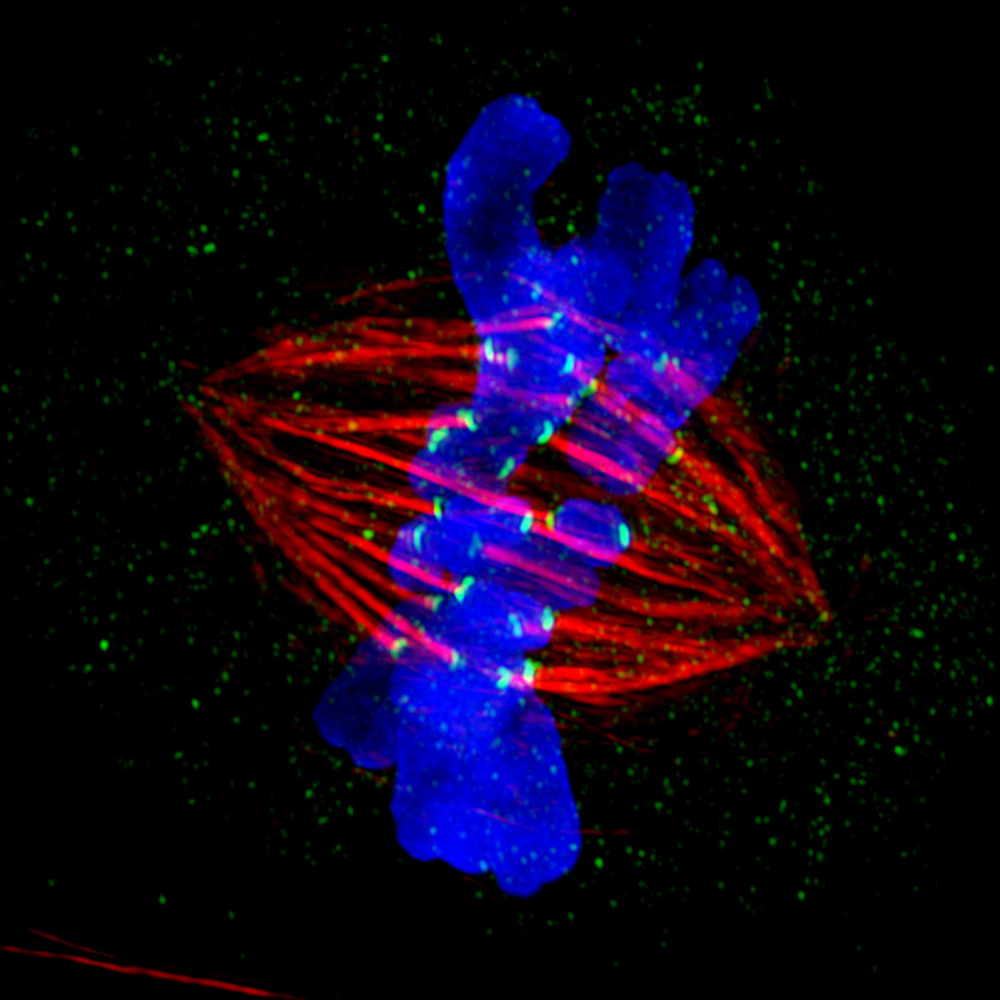
The various events of the jail cell cycle are tightly regulated. If errors occur at any one stage, the cell tin end jail cell division from progressing. Such regulatory mechanisms are known equally cell cycle checkpoints, co-ordinate to Cooper. In that location are 3 checkpoints within the G1, G2 and Thou phases. Damaged DNA stops jail cell cycle progression in the G1 phase, ensuring that an abnormal cell will not be replicated. The G2 checkpoint responds to incorrectly duplicated, or damaged DNA. It prevents cells from moving into the M phase until the DNA is replicated correctly, or until the harm is repaired. The M phase checkpoint tin can halt the cell cycle in metaphase. Information technology ensures that all the sister chromatids are properly hooked upwardly to the mitotic spindle and that sister chromatids move towards contrary ends of the cell.
"If things go wrong and are not corrected, yous end up with some cells that get extra chromosomes and some that are deficient," Hoyt said. "Oftentimes those cells have a genotype[DNA sequence] that won't support the life of the cell, and the will prison cell dice. That's usually a skilful thing."
Sometimes, aberrant cells manage not only to survive, but also to proliferate. Most often, these cells are implicated in cancer. "It [the cell] may take an extra copy of a chromosome that has an oncogene on it. And that's going to start pushing the cell bicycle forwards when it shouldn't be going frontwards," Hoyt said. "That's a first step toward cancer progression." Cancerous cells are known to go through rampant and unregulated prison cell divisions.
The relationship between the cell cycle and cancer has led to the development of a class of cancer drugs that specifically target cancer cells during mitosis. According to anarticle published in 2012 in the journal Cell Expiry & Disease (opens in new tab), "this strategy encompasses a prolonged abort of cells in mitosis, culminating in mitotic cell expiry."
For instance, microtubule poisons end mitosis past targetingmicrotubules (opens in new tab), the main component of the mitotic spindle. Dissentious these thin, hollow, microscopic protein filaments ultimately prevents sis chromatids from being pulled apart. Examples of microtubule poisons are the medications paclitaxel (Taxol) and vinca alkaloids, which are used to treat a range of cancers, including certain ovarian and breast cancers.
However, microtubule poisons are not without their limitations. According to a 2018 review article published in the journal EMBO Reports, these drugs can sometimes be toxic to brain cells, or cancer cells can get drug-resistant and avoid beingness killed. In an endeavour to find alternate solutions, researchers are looking to develop drugs that target other aspects of mitosis. In 2016, the Food and Drug Assistants (FDA) canonical the use of the new drug Palbociclib in combination with existing anti-cancer drugs to treat certain breast cancers. Palbociclib works by keeping cancer cells frozen in the G1 stage, co-ordinate to a 2017 review article published in the periodical Nature Reviews Cancer (opens in new tab).
The compounds tested in clinical trials and so far accept had some success just take non been as effective as microtubule poisons, according to EMBO Reports. Nevertheless, targeting mitosis in the treatment of cancer remains an active surface area of enquiry.
Additional resources
- The Biology Project (University of Arizona): The Cell Cycle & Mitosis Tutorial
- Biology4Kids.com: Mitosis — When Cells Split Apart
- Scitable (Nature): Mitosis (opens in new tab)

How Does Mitosis Ensure That Each Daughter Cell Has The Same Genetic Makeup As The Paent Cell?,
Source: https://www.livescience.com/52512-mitosis.html
Posted by: presleynant1976.blogspot.com
0 Response to "How Does Mitosis Ensure That Each Daughter Cell Has The Same Genetic Makeup As The Paent Cell?"
Post a Comment