

How To Create A Pipeline In Jenkins
Pipeline ships with built-in documentation features to make it easier to create Pipelines of varying complexities. This built-in documentation is automatically generated and updated based on the plugins installed in the Jenkins instance.
The built-in documentation can be found globally at ${YOUR_JENKINS_URL}/pipeline-syntax. The same documentation is also linked as Pipeline Syntax in the side-bar for any configured Pipeline project.

Snippet Generator
The built-in "Snippet Generator" utility is helpful for creating bits of code for individual steps, discovering new steps provided by plugins, or experimenting with different parameters for a particular step.
The Snippet Generator is dynamically populated with a list of the steps available to the Jenkins instance. The number of steps available is dependent on the plugins installed which explicitly expose steps for use in Pipeline.
To generate a step snippet with the Snippet Generator:
-
Navigate to the Pipeline Syntax link (referenced above) from a configured Pipeline, or at
${YOUR_JENKINS_URL}/pipeline-syntax. -
Select the desired step in the Sample Step dropdown menu
-
Use the dynamically populated area below the Sample Step dropdown to configure the selected step.
-
Click Generate Pipeline Script to create a snippet of Pipeline which can be copied and pasted into a Pipeline.
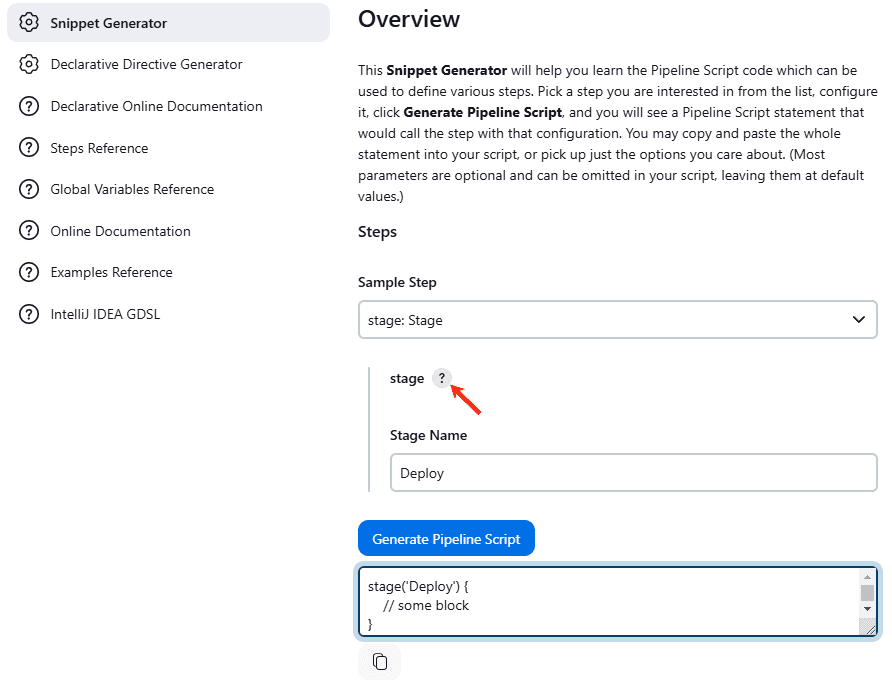
To access additional information and/or documentation about the step selected, click on the help icon (indicated by the red arrow in the image above).
Global Variable Reference
In addition to the Snippet Generator, which only surfaces steps, Pipeline also provides a built-in "Global Variable Reference." Like the Snippet Generator, it is also dynamically populated by plugins. Unlike the Snippet Generator however, the Global Variable Reference only contains documentation for variables provided by Pipeline or plugins, which are available for Pipelines.
The variables provided by default in Pipeline are:
- env
-
Exposes environment variables, for example:
env.PATHorenv.BUILD_ID. Consult the built-in global variable reference at${YOUR_JENKINS_URL}/pipeline-syntax/globals#envfor a complete, and up to date, list of environment variables available in Pipeline. - params
-
Exposes all parameters defined for the Pipeline as a read-only Map, for example:
params.MY_PARAM_NAME. - currentBuild
-
May be used to discover information about the currently executing Pipeline, with properties such as
currentBuild.result,currentBuild.displayName, etc. Consult the built-in global variable reference at${YOUR_JENKINS_URL}/pipeline-syntax/globalsfor a complete, and up to date, list of properties available oncurrentBuild.
Declarative Directive Generator
While the Snippet Generator helps with generating steps for a Scripted Pipeline or for the steps block in a stage in a Declarative Pipeline, it does not cover the sections and directives used to define a Declarative Pipeline. The "Declarative Directive Generator" utility helps with that. Similar to the Snippet Generator, the Directive Generator allows you to choose a Declarative directive, configure it in a form, and generate the configuration for that directive, which you can then use in your Declarative Pipeline.
To generate a Declarative directive using the Declarative Directive Generator:
-
Navigate to the Pipeline Syntax link (referenced above) from a configured Pipeline, and then click on the Declarative Directive Generator link in the sidepanel, or go directly to
${YOUR_JENKINS_URL}/directive-generator. -
Select the desired directive in the dropdown menu
-
Use the dynamically populated area below the dropdown to configure the selected directive.
-
Click Generate Directive to create the directive's configuration to copy into your Pipeline.
The Directive Generator can generate configuration for nested directives, such as conditions inside a when directive, but it cannot generate Pipeline steps. For the contents of directives which contain steps, such as steps inside a stage or conditions like always or failure inside post, the Directive Generator adds a placeholder comment instead. You will still need to add steps to your Pipeline by hand.
Jenkinsfile (Declarative Pipeline)
stage( ' Stage 1 ' ) { steps { // One or more steps need to be included within the steps block. } } How To Create A Pipeline In Jenkins
Source: https://www.jenkins.io/doc/book/pipeline/getting-started/
Posted by: presleynant1976.blogspot.com
0 Response to "How To Create A Pipeline In Jenkins"
Post a Comment